

 Belgique (français)
 Canada (english)
 Deutschland
 España
 France
 Ireland
 Italia
 Luxembourg (français)
 Nederland
 Portugal
 Schweiz (deutsch)
 United Kingdom
 Österreich


Tire load index and speed rating: how to read and check them
91 V, 94 V XL, 99 Y: markings to check before comparing tires
At Tires & Co, a tire size does not end at 205/55 R16. The characters that follow matter too.
Take 205/55 R16 91 V:
- 91 is the load index;
- V is the speed rating.
Here, load index 91 corresponds to a maximum load of 615 kg per tire. The letter V corresponds to a speed category of up to 240 km/h under the conditions specified for the tire. These values help you check whether the tire meets the requirements intended for your vehicle.
Since 2001, our role has been to help drivers look beyond price or brand. Before ordering, check the full tire description, not just its width, aspect ratio and diameter.
The Tires & Co method for checking your ratings
1. Start with your vehicle's specifications
The correct ratings are determined by the vehicle's characteristics, permitted loads and performance.
You can find them:
- in the vehicle handbook;
- on the tire and loading information placard on the driver's door jamb;
- in the vehicle manufacturer's information;
- on your current tires, provided that the fitted set is already compliant.
Simply copying the markings from a tire already fitted is not always enough. When in doubt, the vehicle manufacturer's specifications remain the reference.
2. Read the tire size to the final character
Our search results and product pages show the tire's full description.
For the same 205/55 R16 size, Tires & Co may offer 91 H versions and 91 V versions. The width, aspect ratio and diameter are identical, but the speed rating is not.
Load index: what the number really means
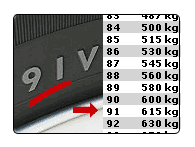
The load index is the number shown after the rim diameter.
In 205/55 R16 91 V, it is the number 91.
This number is not the vehicle's weight. It refers to the maximum load that one tire can carry under its specified operating conditions.
A practical example :Load index 91 corresponds to a maximum of 615 kg per tire
This does not mean that the vehicle can automatically carry four times 615 kg. The limits set by the manufacturer, including the maximum vehicle mass and axle loads, still apply.
Complete load index table
| Load index |
Weight in kg |
|---|---|
| 20 | 80 |
| 22 | 85 |
| 24 | 85 |
| 26 | 90 |
| 28 | 100 |
| 30 | 106 |
| 31 | 109 |
| 33 | 115 |
| 35 | 121 |
| 37 | 128 |
| 40 | 136 |
| 41 | 145 |
| 42 | 150 |
| 44 | 160 |
| 46 | 170 |
| 47 | 175 |
| 48 | 180 |
| 50 | 190 |
| 51 | 195 |
| 52 | 200 |
| 53 | 206 |
| 54 | 212 |
| Load index |
Weight in kg |
|---|---|
| 55 | 218 |
| 58 | 236 |
| 59 | 243 |
| 60 | 250 |
| 61 | 257 |
| 62 | 265 |
| 63 | 272 |
| 64 | 280 |
| 65 | 290 |
| 66 | 300 |
| 67 | 307 |
| 68 | 315 |
| 69 | 325 |
| 70 | 335 |
| 71 | 345 |
| 72 | 355 |
| 73 | 365 |
| 74 | 375 |
| 75 | 387 |
| 76 | 400 |
| 77 | 412 |
| 78 | 425 |
| Load index |
Weight in kg |
|---|---|
| 79 | 437 |
| 80 | 450 |
| 81 | 462 |
| 82 | 475 |
| 83 | 487 |
| 84 | 500 |
| 85 | 515 |
| 86 | 530 |
| 87 | 545 |
| 88 | 560 |
| 89 | 580 |
| 90 | 600 |
| 91 | 615 |
| 92 | 630 |
| 93 | 650 |
| 94 | 670 |
| 95 | 690 |
| 96 | 710 |
| 97 | 730 |
| 98 | 750 |
| 99 | 775 |
| 100 | 800 |
| Load index |
Weight in kg |
|---|---|
| 101 | 825 |
| 102 | 850 |
| 103 | 875 |
| 104 | 900 |
| 105 | 925 |
| 106 | 950 |
| 107 | 975 |
| 108 | 1000 |
| 109 | 1030 |
| 110 | 1060 |
| 111 | 1090 |
| 112 | 1120 |
| 113 | 1150 |
| 114 | 1180 |
| 115 | 1215 |
| 116 | 1250 |
| 117 | 1285 |
| 118 | 1320 |
| 119 | 1360 |
| 120 | 1400 |
The Tires & Co advice
Can I choose a higher load index?
Yes, provided the size and all other characteristics remain compatible with the vehicle.
For example, a tire with load index 94 can carry more than one with index 91. This does not allow you to exceed the maximum vehicle load specified by the manufacturer.
Can I choose a higher load index?
You must not go below the minimum index specified for your vehicle.
If the tires currently fitted have a higher index than the original specification, a lower index may sometimes still comply. Check the vehicle manufacturer's requirements rather than relying only on the tires already fitted.
The Pneus Online approach is simple: first compare the index with the approved fitments for your vehicle, then compare prices and models.
Does XL automatically mean that the tire is compatible?
No. XL means Extra Load and identifies a reinforced tire. However, the numeric index — for example 91, 94 or 98 — is what indicates its actual load capacity.
An XL tire is not automatically suitable for every vehicle or every size.
Speed rating: what the letter tells you
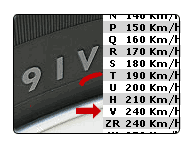
The speed rating is the letter immediately after the load index.
In 205/55 R16 91 V, it is the letter V.
It indicates the maximum speed category for which the tire has been designed while carrying its load under the specified conditions.
It is not:
- a recommended driving speed;
- an invitation to drive faster;
- permission to exceed the legal speed limit.
Complete speed rating table
| Speed index | Speed in km/h |
|---|---|
| A1 | 5 |
| A2 | 10 |
| A3 | 15 |
| A4 | 20 |
| A5 | 25 |
| A6 | 30 |
| A7 | 35 |
| A8 | 40 |
| B | 50 |
| C | 60 |
| Speed index | Speed in km/h |
|---|---|
| D | 65 |
| E | 70 |
| F | 80 |
| G | 90 |
| J | 100 |
| K | 110 |
| L | 120 |
| M | 130 |
| N | 140 |
| P | 150 |
| Speed index | Speed in km/h |
|---|---|
| Q | 160 |
| R | 170 |
| S | 180 |
| T | 190 |
| U | 200 |
| H | 210 |
| V | 240 |
| ZR | >240 |
| W | 270 |
| Y | 300 |
The Tires & Co advice
Can I fit a higher speed rating?
Yes, provided that the tire size and its other characteristics are compatible with your vehicle.
A vehicle designed for class V can, for example, be fitted with class W tires. A higher index does not automatically mean that the tire is better suited to your driving style.
For standard fitment, choose a speed symbol compatible with the characteristics specified for your vehicle.
Before ordering on Tires & Co:
- Check the manufacturer's recommendations;
- Check the full tire designation;
- Respect the maximum speed corresponding to the selected tire.
Can I fit a lower rating?
For standard fitment, you must at least respect the speed symbol specified by the manufacturer.
With certain winter equipment, a lower category may be permitted depending on the vehicle's homologation and the applicable regulations in Canada. So do not automatically choose a lower index simply because it is a winter tire.
An exemption exists for certain snow tires. In this case, the maximum speed corresponding to the tires must be displayed visibly in the vehicle and respected by the driver. The rule therefore cannot be summed up as “going down by just one letter”.
Frequently asked questions about load indexes and speed ratings
Why does Tires & Co show several ratings for the same size?
Because tire size alone does not fully identify a tire.
On our 205/55 R16 page, for example, you may find:
- 205/55 R16 91 H ;
- 205/55 R16 91 V ;
- 205/55 R16 91 W ;
- 205/55 R16 94 V XL ;
- 205/55 R16 94 W XL.
They may share the same width, aspect ratio and diameter, but differ in load capacity, speed rating or construction.
That is why Tires & Co always displays the full description in its results: the characters after R16 are an essential part of the choice.
What really changes from 91 V to 94 V XL?
In both cases, the letter V represents the same speed rating.
The main difference is load capacity:
- 91 corresponds to a maximum of 615 kg per tire;
- 94 corresponds to a maximum of 670 kg per tire;
- XL identifies a reinforced construction designed to carry a higher load at the specified pressures.
That is an additional 55 kg per tire, but it does not automatically make 94 V XL “better”.
Your vehicle must be approved for this specification. A higher index also does not allow you to exceed the maximum load permitted by the vehicle manufacturer.
How can I check the ratings on Tires & Co before adding a tire to my basket?
In our results, the full description appears directly below the tire name.
For example:
Goodyear EfficientGrip Performance 2
205/55 R16 91 V
You can therefore compare the load index and speed rating without opening every product page.
The same results line also shows the season, the manufacturer's specifications, availability and, where available, reviews from our customers. The product page then lets you view the description, available tests and ratings, and leave your own tire review.
The Tires & Co habit: before comparing prices, make sure the tires you are comparing have the correct size and ratings for your vehicle.
Can I replace just one tire with a model that has a different rating?
Do not choose a replacement tire simply because it has the same size.
Start by comparing:
- the full tire size;
- the load index;
- the speed rating;
- the construction;
- the season;
- the model fitted on the other wheel of the same axle.
In Canada, requirements may vary by province or territory. For consistent handling, fit tires of the same type and construction, with comparable wear, on the same axle, and check the vehicle manufacturer's guidance and local rules.
If the model already fitted is no longer available, replacing both tires on the same axle will generally provide more consistent handling. If in doubt, have the combination checked by a tire professional before fitting.
Does a repaired tire keep its speed rating?
The marking on the sidewall remains visible after a repair, but it no longer guarantees the tire's actual condition on its own.
After a puncture, the following must be checked:
- the location and size of the damage;
- the internal condition of the tire;
- any damage caused by driving flat or underinflated;
- whether a suitable repair is possible.
A proper assessment requires the tire to be removed and inspected internally. An externally fitted plug or puncture sealant should be treated as a temporary solution until the tire has been checked by a professional.
Our advice at Tires & Co is simple: after a puncture, do not rely only on the rating printed on the sidewall. Have the tire's actual condition checked first.